Ergonomics in the Workplace: Success Stories
Ergonomics doesn’t have to be complicated. Across the province, employers are fixing everyday hazards with simple, practical changes that make work safer and more comfortable. These examples highlight what’s working—and how simple improvements can prevent injuries.
Halifax Regional School Board
Serving 48,000 students in 136 schools, Halifax Regional School Board (HRSB) is the largest in Atlantic Canada. Within those schools, there are approximately 9,000 staff members operating in a variety of positions.
HAZARD:
HRSB’s Ergonomic Change Team noticed that workers were getting musculoskeletal injuries (MSIs) when taking waste to the outdoor bins. Access was located at the top of the bin, through a heavy lid that needed to be manually held open.
CORRECTIVE ACTION:
The team identified the root cause of their injury trend and then researched solutions. One option was to choose a waste bin with a side door, so staff could lift properly without reaching over the top.
OUTCOME:
HRSB worked with the supplier. They have been switching out existing waste bins for the better suited design over the past 3 years. This has eliminated the need for staff to overreach when throwing out garbage.
Often, simple changes can reduce the likelihood of injury.
MacLeod Group Health Service Limited
MacLeod Group owns and operates 7 long term care nursing homes and 3 assisted retirement living communities in Nova Scotia. They employ over 1,000 people.
HAZARD:
Within the health care sector, MSIs are the most common time loss injuries. 50% of these are linked to some type of handling, transferring, or repositioning of patients. This injuries were happening at MacLeod Group’s 7 long term care homes.
CORRECTIVE ACTION:
A safe resident handling and mobility (SRHM) program is one of the most effective ways to reduce musculoskeletal injuries at work. Strong leadership support is key to making the program work.
When Heather Beaudoin joined as Director of Employee Wellness, she wanted to introduce an SRHM program at all care homes. To make it successful, she needed to work with administrators and frontline workers at each home to identify safety champions.
OUTCOME:
Leadership can come from every level of an organization. With Heather’s support, 2 frontline leaders stepped forward: Karen Doucette (RN) and Anne Underhill (PTA). They’ve shown how much can be achieved through collaboration and mutual respect.
Karen and Anne now play a key role in training staff. They work with other safety champions to monitor the program and keep improving it over time.
STELIA Aerospace North America
STELIA Aerospace specializes in the design, development and manufacture of advanced composite structures and assemblies for the aeronautic, defense, and space markets. Their headquarters and facility in Lunenburg focuses on commercial aircraft.
HAZARD:
Together, STELIA, WCB, and the Department of Labour and Advanced Education discovered that many musculoskeletal injuries were happening because of how materials were stored.
CORRECTIVE ACTION:
STELIA took part in WCB’s Participatory Ergonomic Workshop to help implement an internal Ergonomic Action Response Team. This team performed internal assessments that identified key opportunities to improve. One such opportunity was to add rollers to their storage shelves.
OUTCOME:
Installing shelf rollers eliminated awkward postures. This allowed operators to transfer materials in a safer manner. They were able to use proper lifting techniques to the transfer carts. This significantly reduced the chances of injury.
Northside Community Guest Home
Northside Community Guest Home is located in North Sydney, Nova Scotia. It’s home to 144 residents who live in the nursing home facility and a 25 unit attached enriched housing apartment building. Northside prides itself on the high level of care and accommodations it provides for residents.
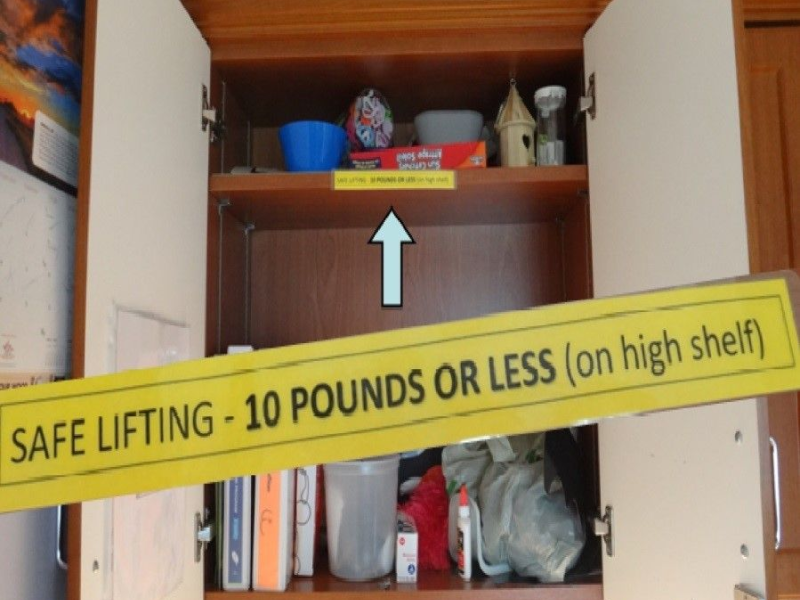
HAZARD:
Northside saw a trend of storing heavy items inappropriately high. This was causing overhead lifting hazards.
CORRECTIVE ACTION:
Visible tags were attached to the shelving, reminding staff to limit weight for items stored on higher shelves.
OUTCOME:
Awareness was greatly improved among staff regarding overhead storage and lifting. Often, simple changes can reduce the likelihood of injury.
Ergonomics and MSI resources
- Ergonomics - Learn about designing tasks, tools, and workspaces so people can work safely and comfortably.
- Musculoskeletal injuries (MSIs) - Get tips on preventing the most common workplace injury.